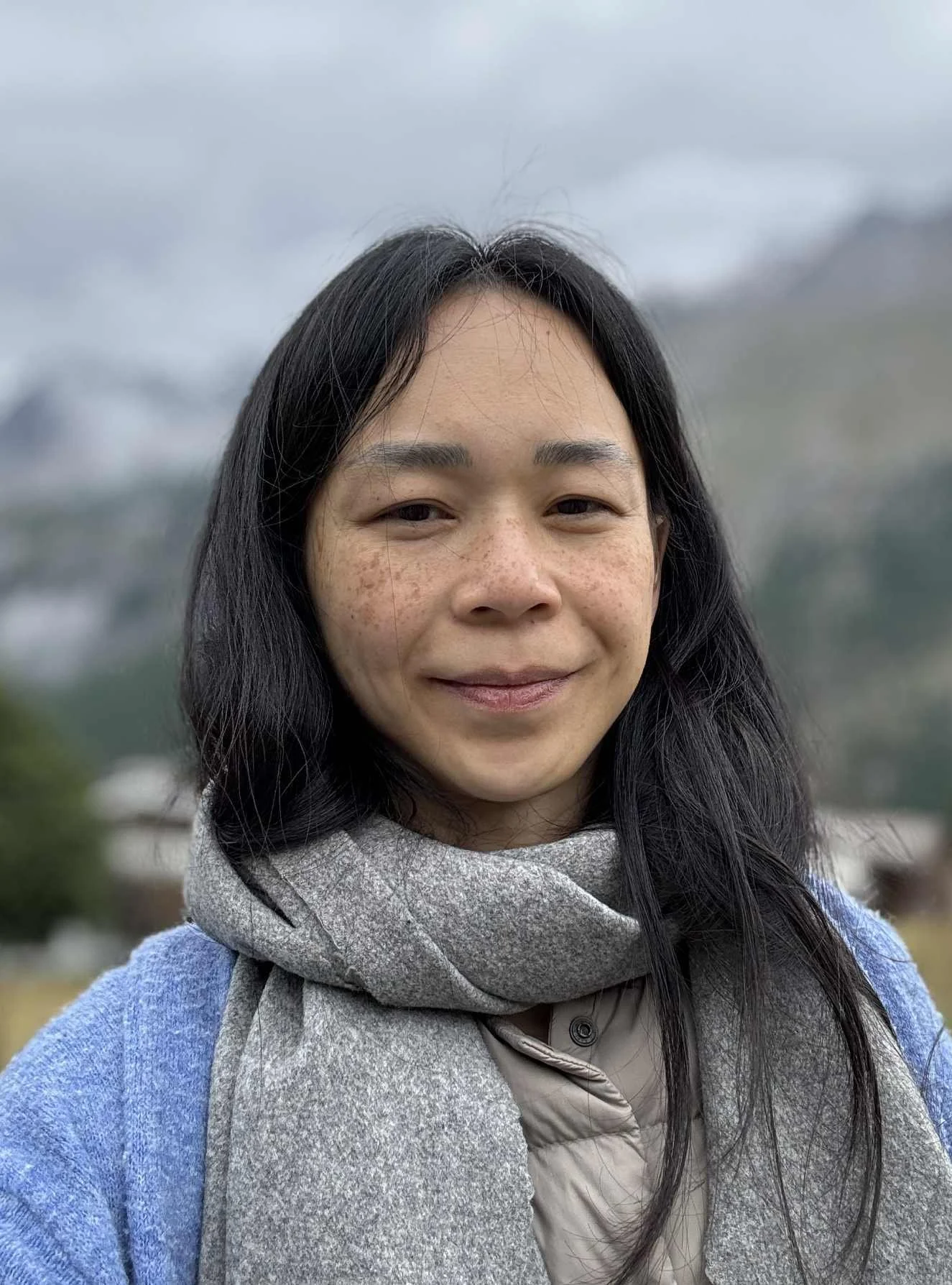
Hi, I’m Yi Jen!
Through expressive arts therapy, creative gatherings, and community-based practices, I offer individuals, groups, and organisations spaces to meet change and transition — exploring moments when life asks us to find a new way forward.
My own experience of migration has drawn me toward questions of identity, belonging, grief, and home, and to the ambiguous spaces of transition — to what becomes possible between what was and what is yet to come. As a mother and woman of colour, I’m particularly attentive to practices of care, connection, imagination, and hope, and to the experiences of women, children, and their caregivers. This has led me to collaborations with organisations and grassroots initiatives supporting migrants, refugees, people seeking protection, and communities living through conflict.
Along the way, I’m grateful to have worked alongside inspiring colleagues, teams, and spaces through the Icelandic Red Cross, First Aid of the Soul, Andrými, Reykjavík City Library, GETA Samtök, and other social projects that continue to be meaningful teachers and sources of nourishment on my path of learning and becoming.
My Story
Walking through many thresholds in life, I have often found myself drawn to the bittersweet experiences and possibilities that emerge in the in-between spaces — places where grief and beauty, darkness and light, uncertainty and possibility, can co-exist.
Raised by the tropical Pacific and the island of Taiwan, I am now making a home in Iceland — another island where my child will grow, as I continue to learn what it means to be a mother, a human being, and a carer of the land. Living between landscapes and cultures, my roots keep stretching, shaping the way I understand change, belonging, and the evolving relationships with ourselves and the worlds around us.
My earlier work and studies were rooted in science, which shaped my appreciation for precision and curiosity about the meanings behind data. Discovering expressive arts offered me a very different lens — a gift that opened me to the beauty of wholeness, to seeing things as they are rather than always seeking to explain, and to the possibilities held within our different ways of knowing. The two disciplines continue to inform each other in elegant and unexpected ways.
Expressive arts inspired me to approach life softly — without always needing to have the answers, and with a deep trust in the creative capacity each person carries. Through presence, curiosity, and embodied understanding, I am called to create space for what is emerging, honour what is not yet here, and make room for the unique ways each person sees, experiences, and makes sense of the world.
I am also curious about how expressive arts can support systems change, restore dignity, and contribute to peacebuilding and justice. My hope is that, by grounding more deeply in the now, we might begin to sense and imagine new ways of being together — bringing the emerging future into the present, and practicing how to make a home together.
A home where all beings are cared for and nurtured, and where softness, compassion, and love have room to take root.
My Philosophy & Approach
-
Salutogenic & resource-oriented — rooted in the work of medical sociologist Aaron Antonovsky (1979), salutogenesis shifts attention from what causes illness towards what supports health. It looks beyond pathology and considers how experiences of distress may also emerge as adaptive, creative responses to life’s adversities. Alongside what is difficult, the practice attends to the resources, relationships, capacities, and conditions that support health, vitality, and a sense of coherence.
Low-skill, high-sensitivity — no artistic skill or prior experience is required to participate in an expressive arts session. Through accessible creative invitations, clients are encouraged to encounter art materials through their senses rather than through technique, creating space for presence, awareness, curiosity, and sensitivity to subtle experience.
Process-oriented — valuing the experience of making, sensing, exploring, and discovering rather than focusing primarily on artistic outcomes.
Phenomenological — staying close to lived experience and attending to its qualities, as well as to what is present and what emerges in the moment. Rather than immediately explaining, analysing, or interpreting an experience, we begin by describing what we notice, without imposing predetermined meanings.
Intermodal — moving between different art modalities, allowing movement, visual art, sound, poetry, theatre, clay, storytelling, and nature to inform and open possibilities for one another.
Imagination and play — reconnecting with vitality and creating space where usual rules and expectations can be loosened, allowing the logic of imagination to take over. This opens possibilities for experimentation and a freer, more expansive way of seeing beyond what is already known.
Relational, co-creative, and agency-centred — recognising the therapeutic space as something co-created. The practitioner brings professional knowledge and care, while the client remains the expert in their own lived experience and an active participant in their process, with freedom to choose, adapt, pause, or decline an invitation.
Culturally sensitive and responsive — recognising that I can never fully understand another person’s lived experience, which is shaped by culture, language, history, and context. I remain committed to continuous learning, reflecting on my own assumptions and limitations, and approaching each encounter with openness and curiosity.
Trauma- and neuroscience-informed — informed by current understandings of trauma, the nervous system, regulation, and embodied experience, with attention to safety, choice, pacing, individual capacity, and needs.
Ecological and contextual — understanding people within the relationships, communities, cultures, environments, and wider social conditions they are part of. Wellbeing is not experienced in isolation, but emerges through our relationships with ourselves, one another, and the worlds we inhabit.
What is Expressive Arts Therapy?
Expressive arts is a holistic, intermodal therapeutic approach that places creativity at the heart of human experience. It is a deeply human and generative practice, rooted in the belief that every person is inherently creative and capable of bringing something new into being — regardless of artistic experience or training.
Rather than interpreting artistic expression through predetermined psychological theories, expressive arts therapy engages directly with the creative process as a way of understanding, exploring, and facilitating change. It trusts the client as the expert of their own experience, and invites curiosity and compassion about what may arrive through the process.
Poetry, sound, visual art, theatre, movement, clay, storytelling, and nature-based practices are all pathways for exploration. By engaging the body and senses, creative practices open space for presence, connection, play, imagination, and resilience — offering ways of expressing and experiencing that words alone cannot fully capture.
Through the process, clients may begin to encounter challenges from new perspectives, discover inner resources, move with complex feelings, and re-weave a sense of meaning and coherence. What emerges does not need to be interpreted or made into something “right”, “complete”, or “beautiful.” The process itself can bear witness to encounter, discovery, healing, and becoming.
Education & Qualification
-
M.A. in Expressive Arts Therapy with a Minor in Psychology — European Graduate School (present)
M.Sc. in Neuroscience — Charité Berlin & Université de Bordeaux (2018)
M.Sc. in Physiology — National Yang-Ming University (2012)
B.Sc. in Animal Science & Technology — National Taiwan University (2010)
-
Expressive Arts Facilitation — step ahead! Expressive Arts Institute Berlin (2024)
Segni Mossi Training (Green & Purple) — Segni Mossi (2024 & 2026)
Perception as a Key to Embodying & Repatterning the Nervous System — Body-Mind Centering® (Online, 2023)
Integrative Somatic Trauma Therapy — The Embody Lab (Online, 2022)
Fluentbody Facilitation — Fluentbody Academy (2022)
200-Hour Yoga Teacher Training — Dynamic Mindfulness Yoga School (2021)
-
u-lab: Leading from the Emerging Future | Presencing Institute (2027)
Clay Field Therapy with Children | Sensorimotor Art Therapy® (2027)
Let’s get to know each other
I believe meaningful work grows through connection. If you’re a fellow practitioner, therapist, or someone working on something that feels close to this practice, or simply curious about where our paths might meet, you are warmly welcome to reach out. Perhaps our paths are meant to cross. :)