Expanding the Range of Play
Play is hardwired into our biology—an innate rhythm woven into the brain’s ancient circuits, where emotions, survival instincts, and social bonds take root. It shapes how we engage with the world and make sense of our experiences, serving as a fundamental force for learning and growth. For children especially, play is a vital language; in times of crisis, it becomes a crucial coping mechanism that helps sustain agency, emotional balance, and resilience.
Play is a state that some researchers describe as “flow.” In play, we loosen our grip on knowledge and control, opening ourselves to new possibilities and surrendering to the rhythm of the process—without needing a defined purpose or outcome. It happens in the doing as if, in the here and now, unfolding with no fixed end.
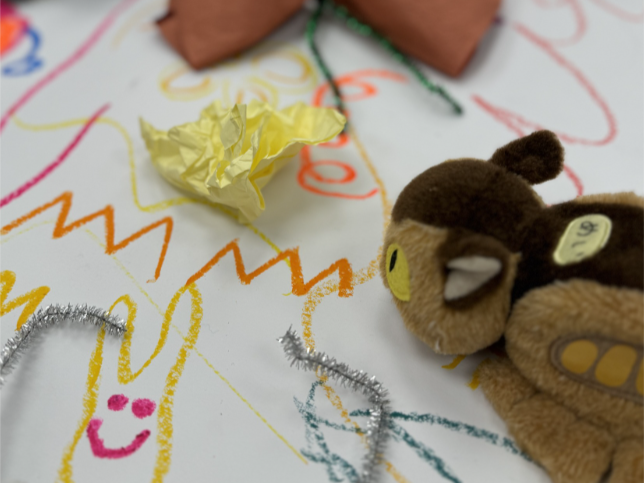
“We suffer when there is no play space,
no gap between what we are and what we can.”
Play is like an alternative landscape to everyday life—spontaneous, experimental, and deeply vital. In expressive arts, we create a space where the usual rules of reality are set aside, and the logic of imagination takes over—opening the door to a freer and more expansive experience of play. “One can feel extremely nourished by not having any demands put upon oneself to exist in a certain way.” (Knill, Levine & Levine, 2005)
The mind at play is alert and engaged, yet at ease. In this state, we reconnect with our vitality, feel a sense of connection, and awaken the capacity to explore and grow creatively. For children and youth—especially those navigating transitions, trauma, or displacement—expanding the range of play is essential, providing a safer space to experiment, take risks, process experiences, and test solutions as they reintegrate into new realities. Within expressive arts sessions, this approach offers opportunities to reimagine possibilities, build adaptive skills, and strenghten emotional and social growth in ways traditional approaches may not reach.
