Being with What Is: A Phenomenological Gaze into Experience and Presence
If poiesis is about creating new meanings, phenomenology reminds us to begin with what is present—attending to the textures, sensations, and moments of now from which curiosity takes roots and creation can grow.
Originating with Edmund Husserl (1931), phenomenology was developed as a way to understand human experience as it is lived, free from preconceived interpretations. His student Martin Heidegger (1927) emphasized that experience is shaped by our being-in-the-world, while Maurice Merleau-Ponty (1945) further highlighted the embodied nature of perception, showing how our senses shape understanding.
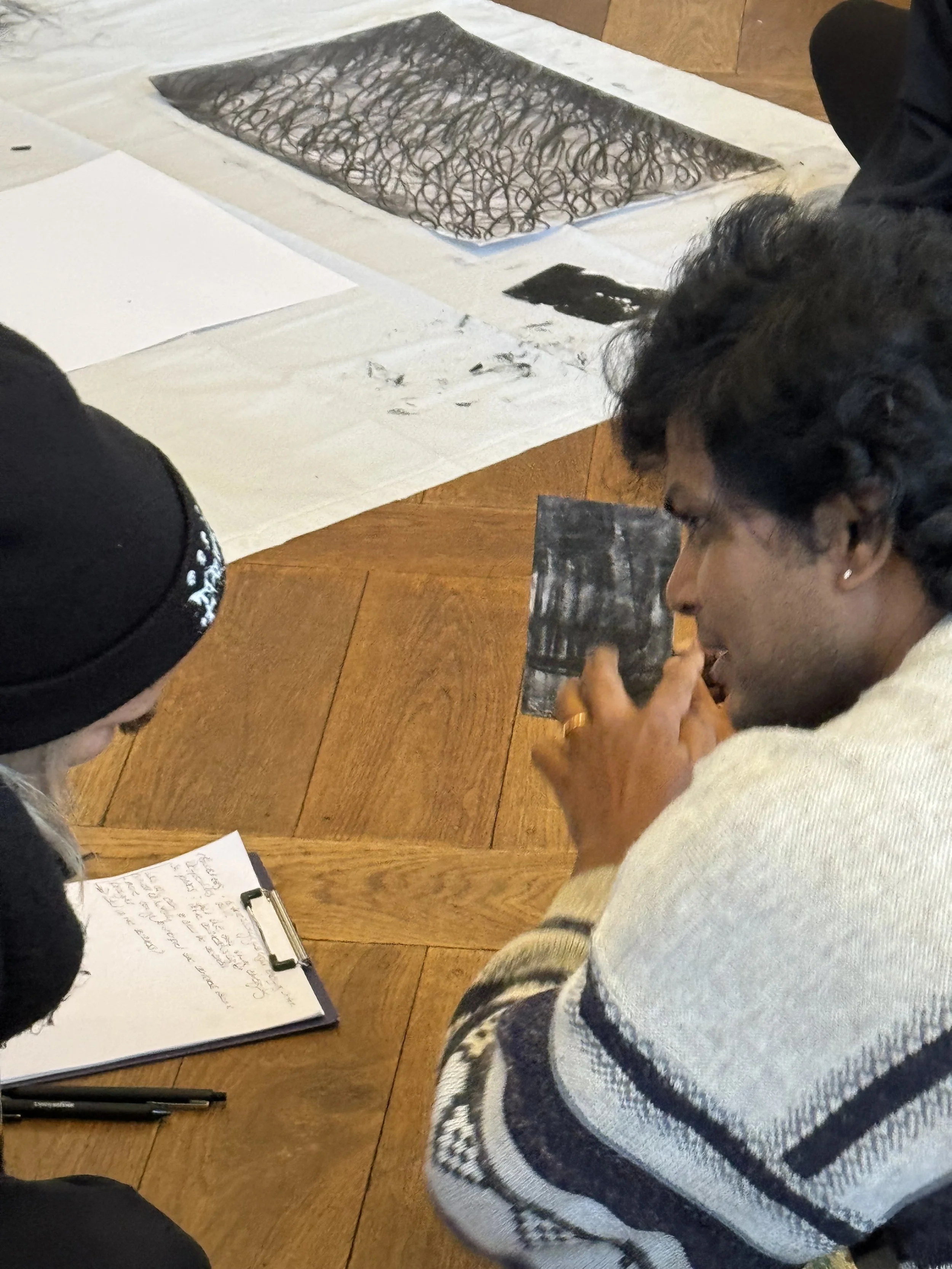
Over time, phenomenology has evolved beyond Husserl’s theoretical framework and is now understood as a moment-to-moment, sensory-based process shaped by our interaction with the world. In expressive arts sessions, warm-up activities heighten participants’ felt sense (Gendlin, 1978), deepening bodily awareness and connection with the environment. By noticing what we see, hear, or sense in the present moment—and describing it simply, without judgment or interpretation—we begin to uncover details that might otherwise be overlooked. This practice of “staying with what is” opens space for curiosity. From there, new insights and possibilities can surface, often revealing perspectives that habitual ways of thinking might have filtered out.
Instead of asking “why” questions, expressive arts practitioners advocate for gentle “how” and “what” questions to stay close to the participants’ lived experience—seeing things as they are and creating space for authentic discovery. Simple invitations like “What do you notice in your body?” or “What do you see?” guide attention toward unfolding experience, where new meaning and insight can emerge.